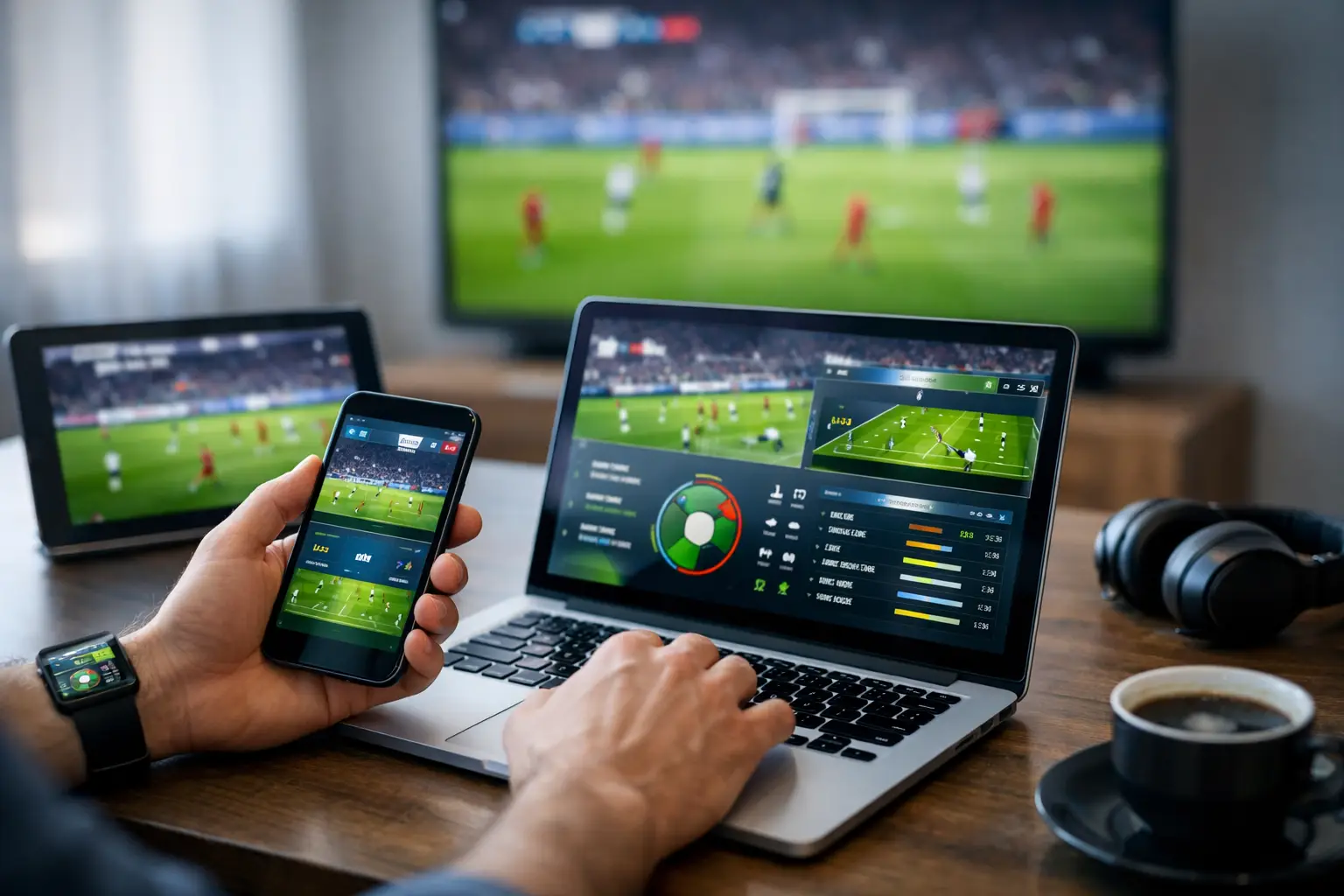
A goal alert arriving 20 seconds late does not feel late until you are in a group chat with someone watching on a faster feed. Then it feels useless. That is the real pressure shaping the future of live match updates. Fans do not just want to know what happened. They want to know it quickly, clearly and with enough context to make sense of the moment.
For football sites, that changes the job. Live updates can no longer be treated as a simple text feed that records goals, cards and substitutions. Supporters now expect speed, accuracy, short analysis and a cleaner way to follow several matches at once. The next stage is not about making updates louder. It is about making them more useful.
What the future of live match updates will actually look like
The biggest shift is that live coverage will become more personalised without losing the basics. A fan following Arsenal v Spurs may want every key event, while another tracking a coupon may only care about goals, red cards and half-time scores across five matches. One format does not suit both.
That means the future of live match updates will move towards layered coverage. At the top level, there will still be the fast match feed – goal, booking, VAR check, full-time. Beneath that, readers will expect optional context such as shot count, momentum swings, tactical changes and what a result means for the table. Not every supporter wants all of that every minute, but many want the choice.
This is where football publishing gets more precise. Instead of flooding every user with the same information, platforms will increasingly let people follow a match in the way that suits them. Some will want raw speed. Others will want smart filtering. The best services will provide both.
Speed still matters most
It is easy to overcomplicate this topic. The first rule of live match updates remains obvious: if the information is slow or wrong, nothing else matters.
Fans are now comparing update services against television broadcasts, club apps, social platforms and betting apps all at once. That creates a tougher standard than before. A site publishing live football updates is no longer only competing with another news site. It is competing with every screen in a fan’s hand.
But speed on its own is not enough. Very fast bad information is worse than a slight delay with proper verification. VAR has made that problem more visible. A goal can be scored, ruled out, checked and given after a long pause. During that spell, fans want updates that reflect uncertainty properly. Saying “goal” too early can be misleading. Saying nothing for too long can be just as frustrating.
The strongest live services will be the ones that handle these grey areas well. They will report the event quickly, label the status clearly and update it without confusion.
The role of automation
Automation will do more of the heavy lifting, especially for routine events. Data feeds already power much of modern match tracking, and that will only increase. Corners, cards, substitutions and kick-off times can be delivered faster by automated systems than by manual entry.
That helps with coverage scale. On a busy Saturday, a football site may need to cover Premier League, Championship, League One, League Two and major European fixtures at the same time. Automation makes broad coverage possible.
Still, automation has limits. It can tell you a substitution happened. It cannot always tell you why it matters. If a right-back goes off injured and a winger drops deeper to cover, supporters often want the football reason, not just the data point. That is why the future is unlikely to be fully automated. It is more likely to be a mix of machine speed and human judgement.
More context, but only when it helps
For years, many live match pages treated context as an afterthought. You got the score and a basic timeline. That was enough if all you wanted was the result. It is less enough now.
Modern supporters are used to more detail. They want to know whether a side is dominating or simply leading against the run of play. They want to know if a red card changed the match, whether a late goal was coming, and how a result affects title races, relegation battles or qualification places.
The key point is restraint. Too much data can make live updates harder to read, not better. A wall of expected goals, heat maps and possession chains is not useful to everyone in the 78th minute of a tense match. Better context is selective context. It tells the reader what matters now.
For example, if a team has not had a shot on target in an hour, that matters. If a side has dropped ten yards deeper since half-time, that matters. If a draw keeps one club in the top four and sends another out of the play-off spots, that matters as well. The best update formats will surface this kind of context at the right moment instead of dumping stats continuously.
The rise of personal alerts and filtered feeds
One of the clearest changes ahead is not on the match page itself. It is in alerts.
Fans increasingly want to decide what counts as a meaningful update. Some only want goals. Some want line-ups, kick-off, half-time, full-time and major incidents. Some care about one club only, while others track several leagues at once. A single alert setting for everyone is too blunt.
The future of live match updates is likely to be shaped by better filtering. That could mean alerts based on favourite clubs, competitions, players or even match states. A supporter might ask for updates only when an underdog takes the lead, when a match enters added time level, or when a result changes the table.
For football readers, that is useful because it reduces noise. For publishers, it can build stronger repeat habits. If the update system respects the user’s attention, they are more likely to keep using it.
Following more than one match
This matters even more on busy fixture days. A lot of supporters are not watching one match in isolation. They are following their own team, keeping an eye on rivals and checking a European tie later in the evening.
Live coverage will keep moving towards multi-match experiences. Not every fan wants a separate page for each game with no overview. Many want a quick screen that shows the key movements across a league or round, then lets them tap into deeper detail where needed.
This is especially relevant during final-day drama, cup rounds and Champions League nights, when standings and outcomes can change every few minutes. In those moments, the update service that keeps the whole picture clear has a real advantage.
Audio, visuals and the second-screen habit
Text remains the backbone of live updates because it is fast and easy to scan. That is unlikely to change. But text will sit alongside more lightweight visuals and short-form media.
Simple shot maps, momentum bars, formation changes and quick video-free animations can add value if they load quickly and do not clutter the page. Supporters using live updates are often doing so as a second-screen habit while at work, travelling or watching another game. They need information that is instant, readable and mobile-friendly.
That is why design matters as much as features. If the page is slow, crowded or filled with interruptions, the service fails its main job. The future is not a more bloated live page. It is a cleaner one that presents more useful information without making the experience heavier.
Trust will separate the best from the rest
As more platforms chase speed, trust becomes more valuable. Football supporters notice which services are consistently accurate and which ones overreact to every flash event.
That trust is built in small ways. Correct competition labels. Reliable kick-off times. Fast corrections. Clear wording around VAR and abandoned matches. Sensible handling of rumours during live coverage. These details sound basic, but they shape whether fans come back.
For a football-only publisher, this is an advantage. A focused site can build its coverage around what match-going and match-following supporters actually need, rather than stuffing the page with unrelated content.
The future of live match updates is not just faster technology. It is better editorial judgement about what deserves attention and what can wait.
What fans should expect next
Over the next few years, supporters should expect live updates to become quicker, more tailored and more aware of context. They should also expect a few trade-offs. Personalisation is useful, but only if it stays simple. Automation is efficient, but only if accuracy stays high. More data can help, but only if it improves understanding rather than slowing everything down.
That balance will decide which services become part of a fan’s routine. Football moves quickly, but following it should not feel messy. If live updates can give supporters the right information at the right time, in the right format, they will remain one of the most practical ways to stay close to the game – especially when you cannot watch every minute yourself.
The next improvement may not be the flashiest feature. It may simply be opening a match page and getting exactly what you need straight away.
One thought on “The Future of Live Match Updates”
Comments are closed.