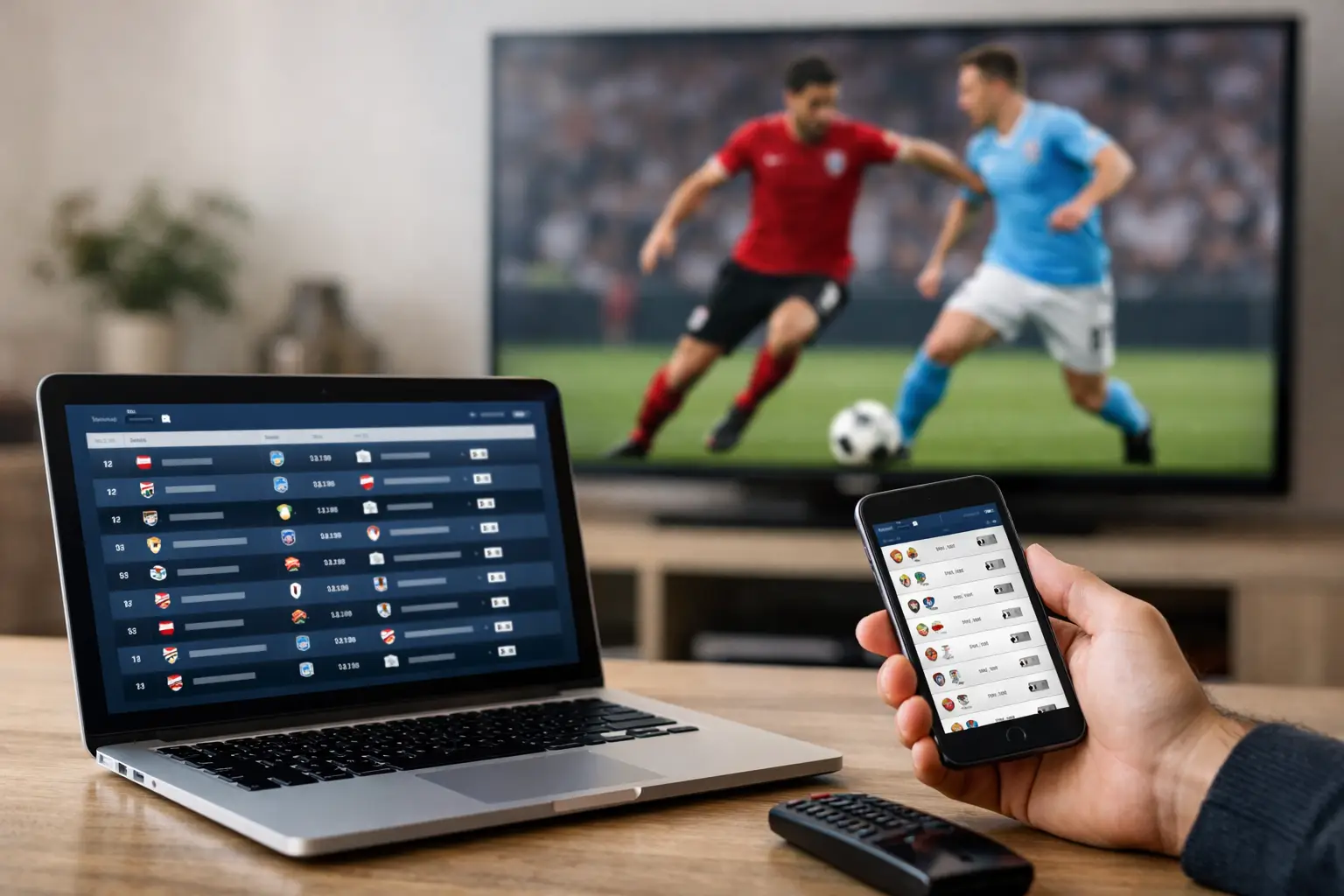
If you have ever opened three different apps on a Saturday morning and still not known where the match is on, you already know the problem. Knowing how to find televised fixtures quickly matters when kick-off times shift, rights are split across broadcasters, and not every big game ends up on live TV.
For football fans, the easiest approach is not checking more sources. It is checking the right ones in the right order. That saves time, cuts out bad information, and helps you spot late changes before you miss the start.
How to find televised fixtures without wasting time
The fastest method is to begin with the competition or club fixture list, then confirm the broadcaster, then check the channel schedule on the day of the match. That order matters because fixture pages usually tell you whether a game has been selected for television, while broadcaster schedules confirm the exact time and platform.
If you do it the other way round, you can end up searching a channel guide for a match that was never picked up in the first place. For major competitions, TV selection can also affect kick-off times, so the listed match time on an older fixture page may no longer be correct.
A simple working routine looks like this. First, find the match in the official fixture list for the league, cup, or club. Next, look for any note showing live coverage or a revised kick-off time. Finally, check the broadcaster schedule on the same day to make sure nothing has changed.
Start with the fixture source, not the TV guide
A fixture source tells you what is being played. A TV guide tells you what is being shown. Those are not always the same thing.
This is where many fans lose time. They search by channel first, especially if they already subscribe to one broadcaster. But football rights are split across several platforms, and some matches are not televised at all. Starting with the fixture source gives you the full picture before you narrow it down.
For league football, that usually means checking the competition schedule. For club football, it may be quicker to check the club fixture page first, especially if you only follow one side closely. Club pages are often useful for confirmed kick-off times and competition names, but they are not always the best place for broadcast detail. That is why confirmation matters.
If you follow several competitions at once, keep your approach consistent. Check the match listing, note the exact date and kick-off, then move to the broadcaster. It sounds basic, but this is the quickest way to avoid mixing up similar fixtures across different competitions.
Where televised fixture information is usually most reliable
Not all fixture information is equal. Some sources update quickly. Others lag behind, especially when broadcasters finalise selections late or when cup ties move after scheduling decisions.
The most reliable places are usually official competition pages, official club fixture pages, and broadcaster schedules. News and football publishing sites can also be useful because they often pull the key information into one place for easier browsing, which suits fans who want fast access without checking each competition separately.
The trade-off is simple. Official sources are usually the safest, but they can be slower to scan if you are checking several matches. Aggregated football coverage is often quicker to use, but you still want to verify the channel and kick-off if the game is close.
That matters even more in the UK, where television rights are spread across domestic league coverage, cup competitions, Europe and international football. One broadcaster may show a full round of one competition and none of another.
How TV rights affect how to find televised fixtures
If you want to get better at how to find televised fixtures, it helps to understand why it can feel inconsistent. Not every competition sells rights in the same way, and not every matchday gets full live coverage.
Some leagues have selected games live each round. Some cup competitions split coverage between broadcasters. Some European fixtures are grouped by package. International football can be even less predictable, particularly for qualifiers, friendlies and youth tournaments.
That means a match being important does not guarantee it will be easy to find on television. It also means a game can move from one platform to another from one season to the next. Fans who rely on memory from last year are often the ones caught out.
The practical point is this: check the current broadcaster, not the one you assume still has the rights. Rights deals change. So do streaming arrangements. If you are searching for a fixture based on habit, you can end up looking in the wrong place.
Matchday checks matter more than early-week checks
Early in the week, fixture information is useful for planning. On matchday, it needs to be exact.
Broadly speaking, checking televised fixtures twice is the safest approach. Check once when you are planning your week, then check again on the day of the game. This second check is the one that catches last-minute time moves, channel changes, and platform switches from a main channel to a streaming service or red-button option.
This matters most during busy periods. Festive schedules, cup rounds and European weeks often create overlaps. Broadcasters can adjust presentation details, and listings can be tidied up close to kick-off. If you only checked once four days earlier, you may still have the right match but the wrong channel.
Common mistakes when searching for televised fixtures
The biggest mistake is assuming every fixture is being shown live. A close second is relying on a search result without checking the date.
Football calendars move quickly. Search engines can surface old fixture pages, outdated TV guides or previous season listings. If the page does not clearly show the competition, date and kick-off, it is not enough on its own.
Another common problem is confusing live TV with highlights coverage. A listing for highlights, delayed coverage or a match report is not the same as a live televised fixture. If your goal is to watch the match as it happens, make sure the source says live and gives a specific broadcast time.
Fans also get caught by regional differences. A match listed for television in one territory may not be available in another. For UK readers, checking the UK schedule specifically helps avoid that issue.
A quicker way to track several teams and competitions
If you follow one club, the process is simple. If you follow the Premier League, EFL, Europe, international football and a few rivals for good measure, things get messy quickly.
The easiest fix is to build a short routine you can repeat. Use one fixture source for matches, one news-led football source for quick overview, and one broadcaster check for final confirmation. That cuts out random searching and helps you compare matches in the same window.
You do not need a complicated system. What you need is consistency. If every Saturday starts with the same three checks, you will spend less time hunting and more time actually following the football.
This is where category-led football coverage can help. A dedicated football site that separates news, matches and results makes it easier to move from schedule checking to live follow-up without switching context. For regular fans, that convenience matters more than having dozens of extra features you will never use.
When televised listings are less straightforward
Some fixtures are easy to find because the coverage is announced well in advance. Others are not.
Lower-league matches, youth football, early-round cup ties and some overseas competitions may have less visible listing information. In those cases, broadcaster schedules can be harder to scan and fixture pages may not make television status obvious straight away. It does not always mean the match is unavailable, but it does mean you may need to wait longer for confirmation.
Postponements can create the same issue. A rearranged fixture may appear in the schedule before the broadcast details are fully updated. That gap can catch people out, especially if they assume the original TV arrangement still applies.
If the information looks unclear, the safest move is to treat it as unconfirmed until a current fixture listing and a current broadcaster listing match up.
What to check before kick-off
Right before the match, there are only three details that matter: the correct date, the correct kick-off time, and the correct broadcaster or platform.
If those three line up, you are usually fine. If one looks off, check again. That may sound obvious, but it is the difference between finding the game first time and arriving ten minutes late because the televised slot changed.
Football coverage moves quickly, and the simplest systems tend to work best. Start with the fixture, confirm the broadcaster, then recheck on matchday. Do that regularly and finding televised football becomes routine rather than guesswork.
The useful habit is not checking everything. It is checking the right details at the right moment.