If you have opened a scores page expecting kick-off and instead seen “delayed”, the obvious question is: why are football matches delayed? The short answer is that a football fixture only starts or continues when officials believe it is safe, fair and playable. That decision can be affected by weather, crowd issues, travel problems, medical emergencies, stadium faults or events inside the match itself.
Most delays are not dramatic. Some last ten minutes while a goal frame is checked or a crowd issue is dealt with. Others push kick-off back much longer, and in rarer cases a game is suspended or abandoned. The key point is that delays are usually about protecting players, staff, supporters and the integrity of the match.
Why are football matches delayed before kick-off?
Pre-match delays usually happen because something is not ready. That can mean the pitch is unsafe, one team has not arrived, the stadium has a technical problem, or the authorities are dealing with a security concern.
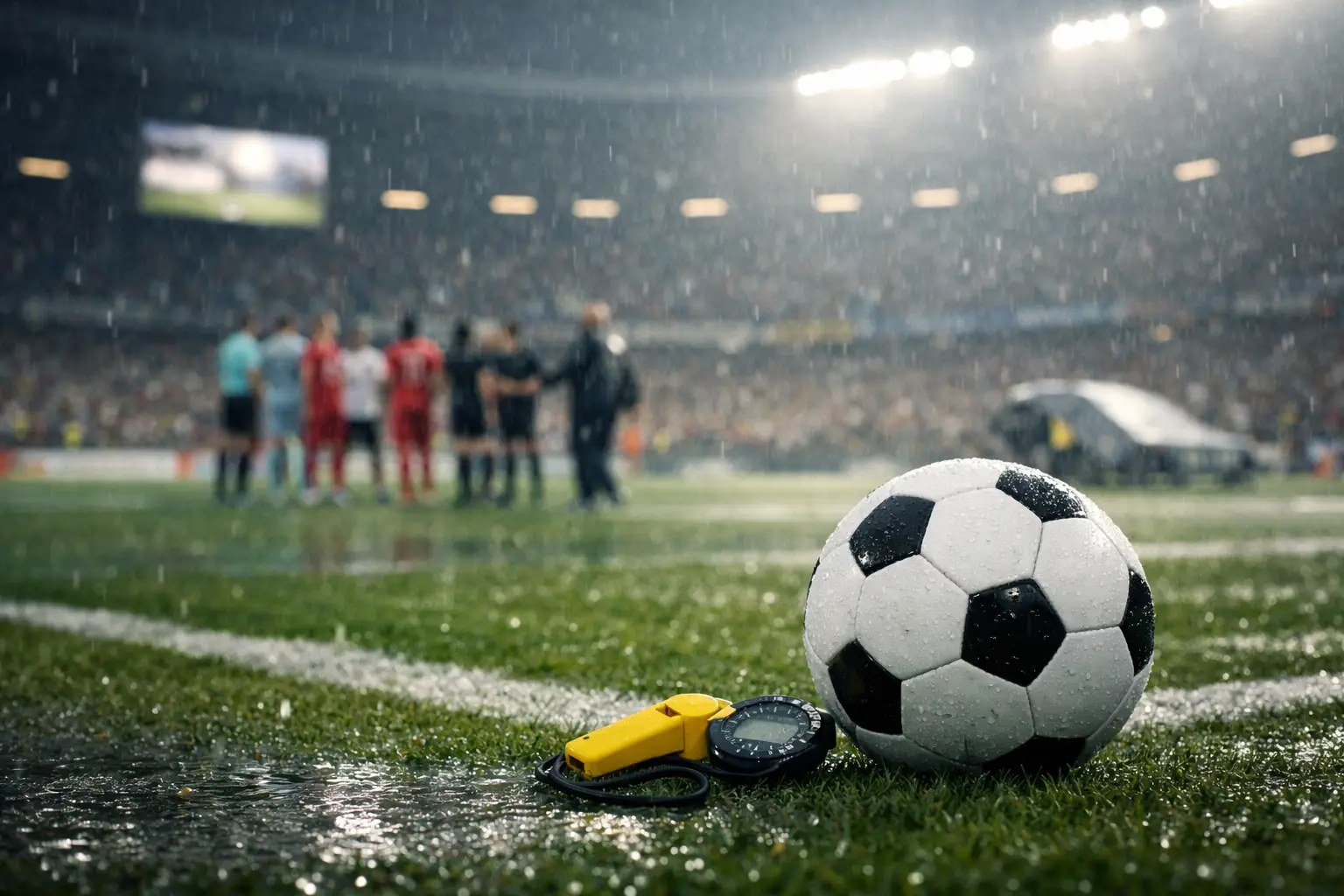
Bad weather is one of the most common reasons. Heavy rain can leave water sitting on the surface, which changes how the ball moves and raises the risk of slips and muscle injuries. Snow can make line markings hard to see. Fog can become a problem if players, officials or supporters cannot properly see what is happening. Lightning is taken especially seriously because of the direct safety risk.
Travel disruption can also push kick-off back. Team coaches can be delayed by severe traffic, road closures, vehicle faults or wider transport issues. In European competitions and international football, flight delays and airport disruption can create knock-on problems. Officials will not automatically postpone a match for late arrivals, but organisers may decide a short delay is the fairest option if the issue is outside a club’s control.
Then there are stadium and operational faults. Floodlight failures, turnstile problems, issues with communication systems, damage in the dressing rooms or concerns around the goalposts can all lead to a hold-up. These sound minor until you remember how tightly regulated professional football is. If one part of the matchday setup does not meet the required standard, the game may have to wait.
Weather delays in football
When fans ask why are football matches delayed, weather is usually the first answer that comes to mind. It is also one of the few causes everyone can see for themselves.
Waterlogged pitches remain a major issue despite improved drainage in modern grounds. Even top-level stadiums can struggle if rainfall is extreme. The referee inspects the pitch and checks things like ball roll, footing and whether the surface is becoming dangerous. Lower-league and non-league matches are even more exposed because the infrastructure is often less advanced.
Snow and frost create different problems. A frozen pitch can be hard and dangerous, while heavy snow affects visibility and line recognition. Grounds teams can work for hours to make a surface playable, but there is a point where the referee has to decide whether the game can go ahead properly.
High winds can matter too. Strong gusts affect crosses, goal kicks and long passes, but they also create concerns in the stands and around temporary structures, advertising boards or broadcast equipment. The same applies to storms more broadly. A match is not only about the grass and the ball. The whole venue has to be safe.
Who decides if weather causes a delay?
The referee has the final say on the field of play, but that decision is rarely made in isolation. Stadium safety officers, competition organisers, police, club staff and grounds teams all feed in. In some cases there are pitch inspections hours before kick-off, then another closer to the start time.
That is why supporters sometimes see mixed messaging. A club may say the game is still on, then a later inspection results in a delay or postponement. Conditions can change quickly, especially during winter.
Match delays during the game
A fixture can also be delayed after it has started. At that stage, the referee may stop play temporarily, suspend the match, or in extreme cases abandon it.
Player injuries are one obvious reason. Most injuries only stop play briefly, but serious incidents can lead to long delays while medical staff treat a player on the pitch. Head injuries are treated with extra caution, and any situation involving a stretcher, oxygen or emergency care can hold up the match for several minutes.
Medical emergencies in the crowd can also stop a game. This has become more visible in recent years, with players and officials alerting medics when a supporter needs urgent treatment. These pauses can be lengthy, and rightly so. Football becomes secondary if someone in the stands needs immediate care.
VAR checks sometimes add to the delay, although they are usually short rather than full suspensions. Offside reviews, penalty incidents, red-card checks and cases of mistaken identity can all slow the restart. Fans may not always like the wait, but the aim is to reach the correct decision. That said, there is a trade-off: more accuracy can mean less flow.
Equipment and technical issues matter as well. A damaged net, a faulty communication line between officials, or a problem with the match ball supply can interrupt play. In televised matches, a wider systems problem may also need resolving, though broadcast concerns alone should not outweigh sporting priorities.
Security and crowd-related delays
Security is another major answer to why are football matches delayed. This can range from minor crowd congestion outside the stadium to incidents serious enough to stop the match entirely.
If large numbers of supporters are stuck outside because of turnstile issues, police filtering or transport delays, kick-off may be pushed back. Organisers will consider whether starting on time is sensible if many fans are still trying to enter safely. This tends to happen in high-demand fixtures where crowd movement is harder to manage.
Inside the ground, crowd trouble can force a stoppage. Objects thrown onto the pitch, clashes in the stands, pitch invasions or discriminatory abuse can all lead to a delay while the situation is brought under control. Depending on the severity, the referee may take the players off the pitch.
These cases are handled carefully because there are competing priorities. Officials want the fixture completed, but not at the cost of safety or basic order. A short pause may calm things down. If not, suspension or abandonment becomes a real possibility.
Less obvious reasons football matches are delayed
Some delays make immediate sense. Others are less obvious to people following from home.
Administrative issues can matter. Missing paperwork, problems with team sheets, kit clashes discovered too late, or disputes over player eligibility can create pre-match confusion. These are uncommon at the highest level but not impossible.
There are also ceremonial or event-related delays. A minute’s silence may need to be restarted if interrupted. A pre-match presentation can overrun. In cup finals and major international fixtures, opening ceremonies can affect the exact start time more than people expect.
Occasionally, outside events have an impact. Power cuts in the local area, nearby road incidents, public order concerns or emergency service pressures can all affect a stadium’s ability to host a match on schedule.
Delay, suspension or abandonment?
These terms are often used loosely, but they do not mean the same thing. A delay usually means the match has not started yet, or play is briefly held up. A suspension means the game has started but is paused and may resume. An abandonment means the match cannot continue and the competition authorities will decide what happens next.
That distinction matters because it affects everything from tickets and travel to results and replay rules.
What happens after a delay is announced?
Once a delay is confirmed, clubs and organisers usually provide a revised kick-off time if they have one. Sometimes that comes quickly. Sometimes it does not, because the issue is still being assessed.
For supporters in the ground, the immediate concern is practical: whether to stay in place, whether entry is still open, and whether the issue looks short-term or more serious. For supporters following online, the focus shifts to updates from clubs, leagues and broadcasters.
The important thing is that not every delay leads to a postponement. Many do get resolved. A storm passes, a team arrives, a technical fault is fixed, or medics complete treatment. That is why initial wording can be cautious. Officials do not want to promise a new start time too early and then change it again.
For regular football followers, the main thing to remember is that delays are usually procedural rather than mysterious. If a match has been held back, there is almost always a specific trigger and a chain of people working through it. Some reasons are frustrating, especially when information is slow, but the decision is rarely casual.
The next time a fixture disappears from “starting now” to “delayed”, it usually comes down to one of the same few factors: safety, weather, logistics, security or a serious incident that deserves time and care. For fans, the wait is annoying. For the people responsible for the match, getting it right matters more than getting it started on the dot.